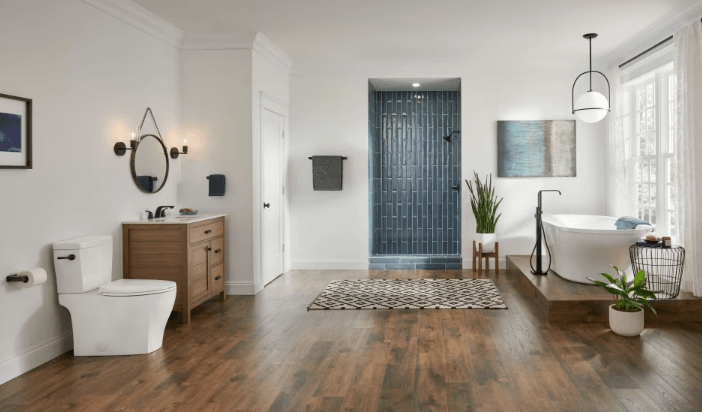
Bathrooms for disabled people can be tricky to get right. The usual pitfalls of a wet and slippery environment, cramped space and need for modesty when dressing can be severely impacted by careful selection of equipment to ensure independence and safety.
Assess your specific needs first
We recommend reading this section first to get an idea of your situation and the tasks that you are having problems with before you look at the products on offer. Is it getting over a bath edge, regaining balance after slipping on a wet floor, standing for long periods of time?
Needs change and what you require today may not be the same in six months. However, it is also important to consider your present limitations and future needs when selecting bath safety products. Although they may appear expensive today, a good bath safety product could save your life and prevent serious injury from a future fall.
Many physical therapists recommend doing a bathroom audit. Instead of actually getting in the shower or bath, stand in the bathroom and go through your routine as if you were actually doing to get in. Identify areas or positions where you feel unstable or where activities cause you pain. This will help you select the appropriate assistive equipment for your specific needs.
Safety features that actually matter
Non-slip surfaces and stability
This is a elegant and compact beauty aid – until it slips from your hands. Prevention is the best method of prevention in this instance, look for bathroom aids with large rubber feet or bases with suction to the bottom. Products with only suction bases will not suffice.
One factor that people often don’t think about when choosing a barbell is the weight capacity. When you see a bar rated for 250kg you might wonder why this is, when the heaviest person to ever lift with it is likely to weigh no more than 120kg. Of course there is the odd strength athlete who might push 180kg for a max effort single, but for most people, most of the time, their bar is subjected to dynamic loads when they move around training, when they reach for the bar to pull up off the floor after a drop, or to pull the bar back to safety after a failed lift. A 150kg capacity for a 70kg user is not excessive.
Material quality and construction
Whether it be a full renovation or a quick refurbishment, the bathrooms in your home are sure to last. The harsh conditions, high levels of moisture, presence of chemicals and extreme temperature changes mean only the strongest most durable materials will withstand the rigors of the bathroom – inferior ones just aren’t going to last. Our vast selection of bathroom tiles, sourced from around the world and designed to withstand anything, can be used on any surface and to create almost any design – get inspiration and ideas from our tile design page.
These products have been designed and made with Stainless Steel, high grade plastic and anodised aluminium constructions meaning they will withstand constant use in the most busiest of bathroom’s. In any environment it is very important that products do not pose any danger or possible injury; in a bathroom especially with the limited space there is a greater risk of injury from sharp edges and protruding bolts. All of our quality products have a quality construction and have been designed with rounded edges and all bolts are hidden. To the average person these small features are of no importance however it is crucial in a low light environment when you will be reaching for them on a regular basis.
See also: Essential Digital Tools for Mastering University-Level Calculus
Comfort and usability considerations
Safety equipment that is uncomfortable to wear is often abandoned. Providing comfortable padding, an ergonomic design, and accurate fit are key features to making medical devices that users need for living comfortable enough to use. Shower safety products, for example, are often left unused because they pale in comparison to typical shower seating which includes features such as height adjustment, drainage holes in the seat and armrests.
Considering physical accessibility for users with disabilities, as well as with cognitive impairments. Simple controls that require no adjusting can be much safer and less frustrating for some people with significant cognitive impairments. A small arthritic knob or a tightly locked mechanism can be very difficult to use for some people with physical disabilities. A large knob or even a simple on/off switch would be much easier.
Installation and maintenance requirements
Too many great products can end up in the trash because they are too hard to install.
While some shower chairs and benches may look great, they can actually require hidden maintenance. For example, wall-mounted grab bars require proper wall studs and special hardware to be installed. However, the amount of maintenance needed between products can vary greatly. For instance, although some shower chairs with fabric components may look better than similar solid plastic or metal models, they need to be washed and replaced regularly. In contrast, basic cleaning is all that is required for the solid plastic or metal shower chair, and normal wear may show up differently on these products.
Getting the sizing and fit right
Most products come in standard sizes, but bathrooms aren’t standard. Measure your bathroom before you spend a dime on anything that can go in it. A product may look perfect online, but be too large to fit between a towel rack and the light switch.
having something height adjustable sounds good in theory, yet in practice that mechanism often fails at the worst possible time. For one user, having fixed height equipment at the proper height is best in the long run. but for multiple users, things get complicated as selecting equipment to use becomes a problem. families will have different heights, and different mobility levels. for these cases, something that is height adjustable is the best solution, despite the reliability issues.
No more guesswork – let us assess your needs and find the right combination of equipment to suit you. We perform our assessments in person and as part of our consultation fee we include a home visit by our occupational therapists. In most cases our equipment assessments are bulk billed through Medicare or your private health insurance. With the right equipment in your bathroom, what may have seemed a challenge becomes a simple task to complete.
We can take the hassle away and allow you to focus on the key issues of safety, durability and size.