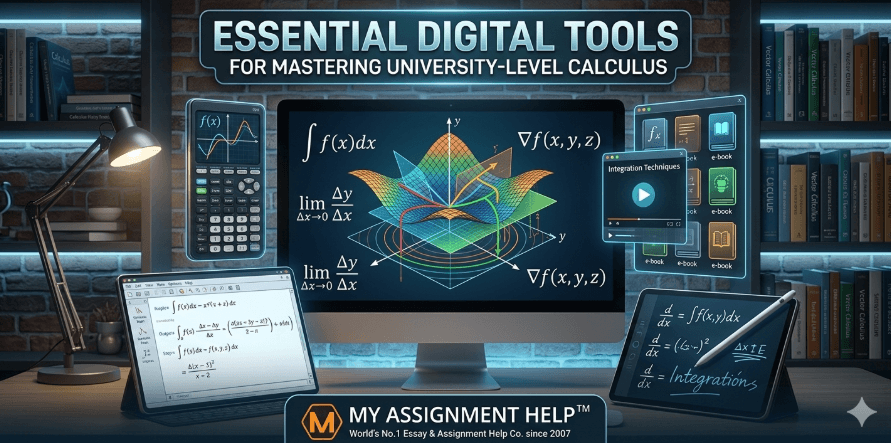
The leap from secondary school mathematics to university-level calculus is often described by students as a “vertical climb.” In Australia, where Group of Eight (Go8) universities maintain rigorous standards for STEM and Engineering degrees, the complexity of differential equations, multivariable calculus, and infinite series can be overwhelming.
However, the modern academic landscape has shifted. Success in 2026 is no longer just about the hours spent with a physical textbook; it is about the strategic integration of digital tools that transform abstract theories into tangible visualisations. The use of AI text humanizer for developers in educational tools can assist in making complex mathematical content more comprehensible and user-friendly, improving student engagement.
The Evolution of the Calculus Learning Stack
For many students, the struggle begins not with the calculus itself, but with the prerequisite skills. Mastery of limits and derivatives requires a bulletproof foundation in algebraic manipulation. If you find yourself bogged down by complex equations before you even reach the integration stage, seeking expert math assignment help can provide the structural clarity needed to progress. This foundational support allows students to focus on the conceptual “why” of calculus rather than getting lost in the “how” of variable isolation.
Recent data from Australian higher education surveys suggests that students who utilize interactive computation engines see a 22% higher retention rate in complex mathematical concepts compared to those using traditional methods alone.
1. Wolfram|Alpha: The Computational Intelligence Engine
Often dubbed the “Siri of Math,” Wolfram|Alpha is indispensable for university students. Unlike a standard calculator, it uses the Wolfram Language to provide step-by-step solutions.
- Why it’s essential: It handles symbolic computation, meaning it can differentiate and integrate expressions without needing numerical values.
- Pro Tip: Use the “Step-by-step” feature to audit your own logic. This is crucial for Australian grading rubrics which heavily weigh “working out” over the final answer.
2. Desmos and GeoGebra: Visualising the Fourth Dimension
Calculus is the study of change, and change is best understood through movement.
- Desmos: Excellent for 2D graphing and understanding how changing a constant shifts a curve in real-time.
- GeoGebra: A powerhouse for 3D calculus. When dealing with volumes of solids of revolution or partial derivatives, being able to rotate a 3D plot is a game-changer.
3. LaTeX: The Language of Academic Professionalism
As you move into second and third-year units, submitting assignments in a Word document becomes insufficient. LaTeX is the standard typesetting system used by mathematicians and engineers worldwide.
- Tool of Choice: Overleaf. It allows for real-time collaboration and ensures your mathematical notations are crisp, professional, and compliant with university submission standards at institutions like UNSW or the University of Melbourne.
Navigating the Academic Workload
The pressure to perform in high-stakes environments often leads to burnout. Many students find that while they understand the theory, the sheer volume of weekly problem sets is unmanageable. In such instances, the decision to hire a professional to do my assignment acts as a strategic academic buffer. This isn’t just about getting a grade; it’s about seeing a model of a perfectly structured, high-distinction (HD) level paper that serves as a study guide for future exams.
Data-Driven Insights: The Correlation Between Tool Use and Grades
According to a 2025 study on digital pedagogy, students who utilised at least three different types of digital mathematical tools (Computational, Visual, and Typesetting) scored an average of 15% higher on final invigilated exams than those who relied solely on lecture notes.
| Tool Category | Recommended Software | Primary Benefit |
| Computation | Wolfram | Alpha / Maple |
| Visualisation | GeoGebra / Desmos | Conceptual clarity of 3D spaces |
| Organization | Notion / Obsidian | Centralised theorem repositories |
| Typesetting | Overleaf (LaTeX) | Professionalism in submission |
Key Takeaways for 2026 Students
- Don’t ignore the basics: Calculus failure is often just “Algebra fatigue.” Fix the foundation first.
- Visualise before you calculate: Use GeoGebra to see the “slice” of the volume you are trying to integrate.
- Automate the formatting: Learn LaTeX early; it saves hours of frustration during thesis or project years.
- Seek Strategic Support: Use professional services not just for completion, but as a benchmarking tool for academic excellence.
See also: How Blockchain Enables Peer-to-Peer Transactions
FAQ: Frequently Asked Questions
Q1: Is using Wolfram|Alpha considered cheating in Australian universities?
A: No, provided it is used as a learning aid. Most professors encourage it for verifying homework, though it is banned in invigilated exams. Always cite your tools if they assisted in a major project.
Q2: Why is LaTeX preferred over Microsoft Word for Math?
A: Word’s equation editor is prone to formatting crashes. LaTeX treats mathematics as a primary language, ensuring that even the most complex triple integrals look professional and are easy to read for markers.
Q3: How do I handle 3D calculus if I have poor spatial awareness?
A: This is where GeoGebra shines. You can input your equation and use your mouse to rotate the object, helping your brain translate 2D equations into 3D shapes.
References
- Tertiary Education Quality and Standards Agency (TEQSA) – Digital Learning Reports 2025.
- Journal of Mathematical Education in Science and Technology – “The Impact of Symbolic Computation on Undergraduate Calculus.”
- University of Sydney – STEM Student Success Data (2024-2026).
Author Bio
Dr. Alistair Vance
Alistair is a Senior Academic Consultant at MyAssignmentHelp. With a PhD in Applied Mathematics and over a decade of experience in the Australian higher education sector, he specialises in bridging the gap between theoretical mathematics and digital application. He has helped thousands of students navigate the rigours of STEM degrees through strategic content planning and expert academic guidance.