In today’s highly competitive manufacturing world, product presentation has become just as important as product quality. Businesses are no longer judged only by what they produce, but also by how consistently and professionally they present it to customers. This shift has made packaging automation a key part of modern industrial success.
One of the most important technologies supporting this transformation is the bottle labeling machine, a precision-driven industrial system designed to apply labels on bottles with speed, accuracy, and uniform consistency. What once required manual effort and time-consuming labor is now handled by intelligent machines that can process thousands of units with minimal variation.
The bottle labeling machine has become an essential part of industries such as beverages, pharmaceuticals, cosmetics, and chemicals, where branding accuracy and compliance information must remain flawless across large production volumes.
From Manual Work to Automated Precision
In earlier production systems, labeling bottles was a fully manual task. Workers applied labels individually, which often resulted in inconsistent placement, bubbles, tilted positioning, and slow production rates. As demand increased, this method became inefficient and unreliable.
Manufacturers then moved toward semi-automated systems, but even those required significant human involvement. Eventually, fully automated labeling machines were developed to solve these challenges and deliver stable, repeatable output.
Today, automation is not just a convenience but a necessity for industries aiming to maintain quality while scaling production.
See also: The Role of Technology in Public Transportation
Core Working Principle of Bottle Labeling Systems
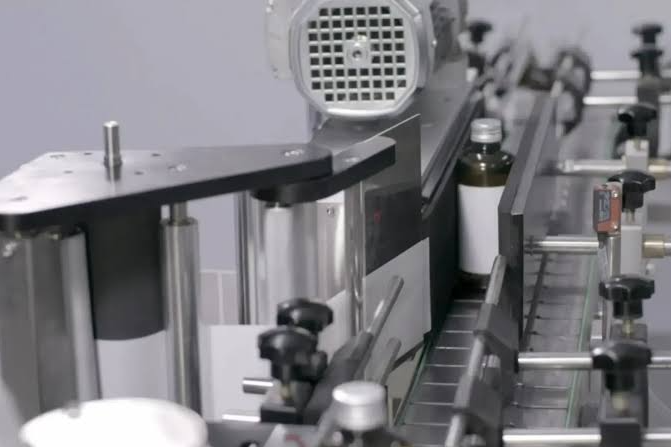
A bottle labeling machine works through a controlled mechanical and sensor-based system that ensures labels are applied accurately onto each bottle. The process begins with bottle alignment, followed by label detection and precise application at a predefined position.
Modern systems are capable of handling multiple bottle shapes, including round, flat, and uniquely designed containers. They can also support different label materials such as adhesive paper, plastic film, and transparent labeling solutions.
The primary objective of a bottle labeling machine is to eliminate variation and ensure that every product in a production batch looks identical in terms of labeling quality.
Why Automation Is Replacing Manual Labeling
One of the main reasons industries are shifting toward automation is consistency. Human workers, even when skilled, naturally introduce variations during repetitive tasks. These small differences can affect brand perception and product presentation.
Automated systems eliminate this inconsistency by performing each labeling task with the same level of precision, regardless of production volume.
Another major advantage is speed. Modern manufacturing requires rapid output, and manual labeling cannot keep up with large-scale production demands. Automated machines solve this problem by operating continuously without fatigue.
Industrial Applications Across Multiple Sectors
Bottle labeling machines are widely used across several industries due to their flexibility and reliability.
In beverage production, they are used to label water bottles, juices, soft drinks, and alcoholic beverages with uniform branding. In pharmaceuticals, labeling accuracy is critical for dosage instructions, safety warnings, and regulatory compliance.
Cosmetic manufacturers rely heavily on these systems to maintain elegant and visually appealing packaging that influences customer purchasing decisions. Similarly, chemical industries use labeling machines to ensure clear hazard information and product identification.
This widespread usage highlights how essential automation has become in modern production environments.
Improving Production Efficiency and Workflow Balance
In a complete production line, labeling is one of the final but most critical steps. If this stage slows down, it can create bottlenecks that affect the entire workflow.
A bottle labeling machine integrates smoothly into production systems, synchronizing with filling and packaging units to maintain continuous flow. This reduces delays and ensures that all processes operate in harmony.
As a result, manufacturers experience improved efficiency, reduced downtime, and higher overall output.
Enhancing Product Branding and Market Identity
Packaging is often the first physical interaction between a customer and a product. A poorly aligned or inconsistent label can negatively affect customer perception, even if the product itself is of high quality.
Automated labeling systems ensure that every product looks uniform, clean, and professionally presented. This consistency plays a crucial role in building strong brand identity and customer trust.
A properly functioning bottle labeling machine helps businesses maintain visual consistency across large production volumes, strengthening their market presence.
Reducing Waste and Operational Inefficiencies
Manual labeling processes often lead to wasted materials due to misalignment, incorrect application, or damaged labels. These errors increase production costs and reduce efficiency.
Automation significantly reduces such waste by applying labels with high precision and consistency. This not only improves material usage but also supports cost-effective production.
Additionally, reducing manual involvement allows employees to focus on monitoring and quality control rather than repetitive physical tasks.
Flexibility and Technological Advancements
Modern bottle labeling machines are designed to handle a wide range of product variations. They can easily adjust to different bottle sizes, shapes, and labeling formats without requiring long setup times.
Advanced systems now include sensors and digital control interfaces that allow automatic adjustments during operation, improving flexibility and reducing downtime.
This adaptability makes them suitable for industries that manage multiple product lines or frequently change packaging designs.
Future Development of Labeling Automation
The future of labeling technology is moving toward smarter and more adaptive systems. With the integration of artificial intelligence, machine vision, and automated calibration, future machines will be able to adjust labeling parameters in real time.
This will reduce human intervention even further and improve accuracy across diverse production environments.
As industries continue to evolve, the importance of systems like the bottle labeling machine will only increase in global manufacturing ecosystems.
Conclusion
The bottle labeling machine has become a vital part of modern packaging industries by improving accuracy, speed, and consistency in production processes. It replaces manual inefficiencies with automated precision, helping businesses achieve higher productivity and better product presentation.
From beverages to pharmaceuticals, its impact is visible across multiple sectors where branding and accuracy are essential.
As automation technology continues to advance, labeling systems will play an even more important role in shaping the future of global manufacturing and packaging standards